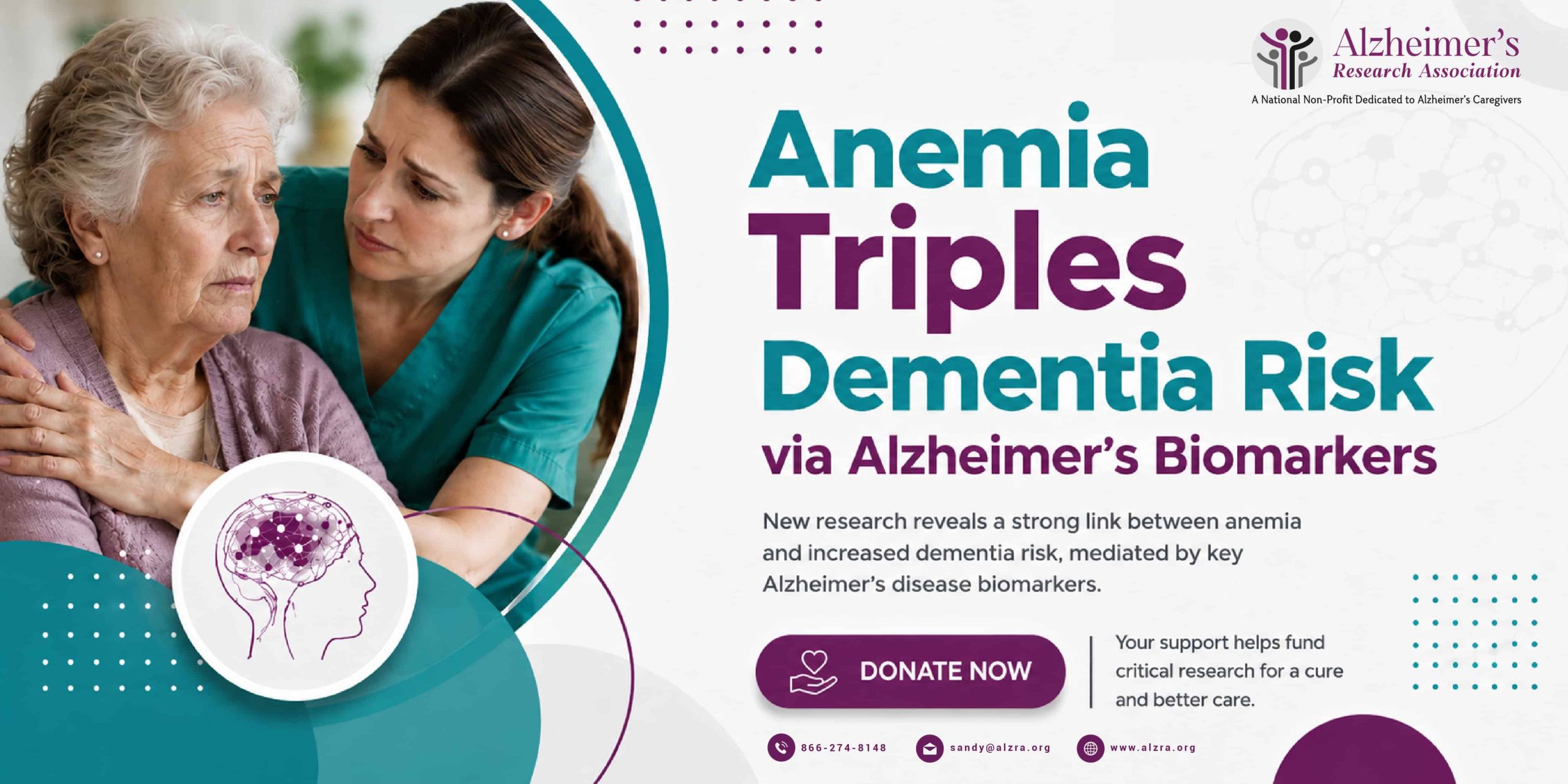
Anemia is a common blood disorder caused by a lack of healthy red blood cells in the body. A recent study looked at the potential relationship between anemia and dementia risk. According to the study’s findings, anemia was linked to higher blood biomarkers for Alzheimer’s disease and an elevated dementia risk over time.
Could a simple and often overlooked blood condition quietly shape the future of brain health? Emerging research is raising an important question: could anemia increase the risk of developing dementia, including Alzheimer’s disease?
Anemia occurs when the body lacks enough healthy red blood cells to carry adequate oxygen to tissues. While it is widely known for causing fatigue and weakness, anemia is also closely linked to a range of chronic conditions, including kidney failure, autoimmune diseases such as rheumatoid arthritis and lupus, and inflammatory bowel diseases like Crohn’s [1]. These associations highlight its broader impact on overall health, far beyond just low energy levels.
Recently, scientists have begun to explore whether anemia’s effects may extend even further—to the brain. New findings suggest that anemia may be connected to higher levels of Alzheimer’s-related biomarkers in the blood, along with an increased risk of dementia over time.
In the recent study published in JAMA Network Open, researchers looked at data from more than 2,200 persons and discovered that people with anemia had more Alzheimer’s disease biomarkers [2].
In the long term, they found that anemia was linked to an increased risk of dementia. Participants with both anemia and greater levels of Alzheimer’s disease biomarkers were at the highest risk of developing dementia.
Understanding the Link Between Anemia and Dementia Risk
Researchers from Sweden and Italy used data from about 2,282 participants in the Swedish National Study on Aging and Care in Kungsholmen. At baseline, none of the participants had dementia, and all were at least sixty years old. Researchers examined information from 2,282 participants in total.
Researchers examined several blood biomarkers of Alzheimer’s disease from participants’ blood samples. Using World Health Organization guidelines, they also assessed participants for anemia [3].
To do this, they checked blood hemoglobin levels to see if they were below a certain threshold. Red blood cells contain a protein called hemoglobin that helps transport oxygen in the body. They also had information on different covariate variables and dementia and mild cognitive impairment diagnoses.
About 8.7% of participants had anemia at baseline. Individuals with anemia were more likely to be older, male, have more chronic illnesses, and have a lower level of education. Alzheimer’s disease biomarkers were more prevalent in anemic participants. Men had higher levels of two specific biomarkers than women did.
There were 16 years of follow-up, with an average of 9.3 years. During the follow-up, about 362 (15.9%) of participants acquired dementia.
Overall, researchers discovered that anemia was linked to a higher risk of getting dementia. The risk of dementia was 66% higher in individuals with anemia than in those with normal hemoglobin levels.
Even after omitting those with mild cognitive impairment and who received a dementia diagnosis within six years of follow-up, researchers discovered that a greater risk for dementia persisted.
However, they found that among those who carried the gene APOE ε4, which raises the risk of Alzheimer’s disease, anemia was not linked to an increased risk of dementia.
Is the Risk Different for Men and Women?
The researchers also observed that the association between hemoglobin levels and increased dementia risk plateaued once hemoglobin reached a threshold slightly above the clinical cutoff for anemia. When they looked at sex, they discovered that this nonlinear relationship was significant for males but not for females.
Finally, researchers discovered that the risk of dementia increased as Alzheimer’s biomarker levels increased and hemoglobin levels declined. On the other hand, those with normal hemoglobin and low biomarker levels had the lowest dementia risk.
One particular biomarker that stood out was NfL (neurofilament light chain). When combined with anemia, having a higher level of this biomarker showed dementia risk, implying an additive interaction. Additionally, APOE-ε4 status seemed to influence several outcomes.
The researchers also discovered that anemia appeared to raise dementia risk and be connected to higher Alzheimer’s blood biomarkers in men than in women. However, they encourage caution against sex-specific findings.
The study indicated that individuals with anemia, greater levels of pTau217, and neurofilament light chain (NfL), a marker of brain cell death, had a higher risk of dementia. The findings also revealed that study participants with no anemia and lower levels of an Alzheimer’s-related blood biomarker had the lowest risk of dementia.
What are the Limitations of the Study?
Although this study offers useful information, it has several limitations. Errors are possible, such as in dementia diagnoses or information provided by participants.
Participants’ hemoglobin levels were within a specific range, and more than 90% of those with anemia had normal-sized red blood cells. As a result, they had limited ability to investigate more severe anemia cases or those with abnormally sized red blood cells. Researchers further point out that they examined Alzheimer’s biomarkers in serum rather than plasma, and that the concentration of these biomarkers is typically lower in serum.
Additionally, they struggled with participants who had incomplete data on biomarkers and hemoglobin levels; these individuals were typically older and had more comorbidities than those they were able to include who had complete data. The researcher pointed out that the removal of these individuals may have resulted in an underestimation of the associations because they were probably more susceptible to dementia and anemia.
Also, there was only baseline data on blood biomarkers. Therefore, researchers were unable to investigate the long-term relationship between hemoglobin and Alzheimer’s disease biomarkers.
Researchers were also constrained by the cohort they chose to study: people from a particular region of Sweden who were already involved in long-term research. Also, most participants in the study were White. It is important to exercise caution when extrapolating the findings to other groups.
The outcomes also differed between men and women, presenting a compelling opportunity for further exploration in future research. Three study authors declared conflicts of interest.
Finally, it is crucial to emphasize that this study did not show a causal association.
Can Treating Anemia Lower Your Risk of Dementia?
The research findings suggest that treating anemia may help prevent dementia.
According to the study’s first author, Martina Valletta, MD, a PhD candidate at Karolinska Institutet, anemia may be a significant risk factor for dementia. Since anemia is relatively simple to diagnose with normal blood testing and, in many cases, curable, it may offer a modifiable target in dementia preventive measures [4].
However, the study is observational, so the researchers cannot say that treating anemia will directly prevent dementia. It remains an area for future research.
In a broader sense, it implies the significance of assessing anemia and not disregarding it.
Alzheimer’s Research Association is a non-profit organization dedicated to helping caregivers of Alzheimer’s disease and dementia. We provide the latest information and news about the illness and helpful tips to help caregivers cope with their daily caregiving challenges. We realize the most important thing that a caregiver needs is financial assistance. Therefore, we provide grants to caregivers to ease their financial burden. Caregivers can apply for grants here: Alzheimer’s Grant Application.
You can also help caregivers in their endeavor by donating as much as possible: Donation To Alzheimer’s Research Associations.
References
- Anemia. American Society of Hematology. https://www.hematology.org/education/patients/anemia. Accessed: 10th June, 2026.
- Valletta, M., Vetrano, D.L., Qiu, C., Canevelli, M., Miccoli, E., Andersson, S., Fredolini, C., Bruno, G., Winblad, B., Fratiglioni, L. and Grande, G., 2026. Anemia and blood biomarkers of Alzheimer disease in dementia development. JAMA Network Open, 9(4), p.e264029.
- Guideline on haemoglobin cutoffs to define anaemia in individuals and populations. World Health Organization. https://www.who.int/publications/i/item/9789240088542. Published: 5th March, 2024. Accessed: 10th June, 2026.
- Freeborn, J. Could anemia increase the risk of developing dementia? Medical News Today. https://www.medicalnewstoday.com/articles/could-anemia-increase-risk-dementia-alzheimers-biomarkers. Published: 22nd April, 2026. Accessed: 10th June, 2026.
- Anemia May Be a Modifiable Risk Factor for Alzheimer’s Disease. Inside Precision Medicine. https://www.insideprecisionmedicine.com/topics/precision-medicine/anemia-may-be-a-modifiable-risk-factor-for-alzheimers-disease/. Published: 17th April, 2026. Accessed: 10th June, 2026.
- Mondal, S. Anemia in adults 60 and older linked to 66% higher dementia risk. Medical Xpress. https://medicalxpress.com/news/2026-04-anemia-adults-older-linked-higher.html. Published: 22nd April, 2026. Accessed: 10th June, 2026.
- Anaemia Triples Dementia Risk via Alzheimer’s Biomarkers. American Medical Journal. https://www.emjreviews.com/en-us/amj/hematology/news/anaemia-triples-dementia-risk-via-alzheimers-biomarkers/. Published: 25th April, 2026. Accessed: 10th June, 2026.